
Download MacArgon for macOS 10.12 or later and enjoy it on your Mac. Allows simulation of argon retention in minerals and rocks. Arbitrary pressure-temperature-time paths can be input that a rock must follow, and calculations are performed as to the diffusion of argon from the mineral grains in question. The MacArgon program ∗ has been used to model published 40 Ar 39 Ar apparent age spectra for white micas from the island of Sifnos, Cyclades, Greece. These micas formed during a period of porphyroblastic mineral growth (M 2) in the epidote-blueschist facies, at 460 °C. Data for a single sample can be exported to Wunderkind or MacArgon for inversion. Wunderkind uses 39Ar release data from furnace-controlled temperature-step-heating ultra-high-vacuum (UHV) diffusion experiments analysed with eArgon. MacArgon allows forward modelling of the effect of arbitrary pressure-temperature-time histories. Allows simulation of argon retention in minerals and rocks. Arbitrary pressure-temperature-time paths can be input. War of the Gods. Zeus raged because of the defiance by King and Queen of Argos.

Research School of Earth Sciences, Australian National University, Canberra, ACT 0200, Australia

A new method has been developed and applied for deriving not only time constraints but also other physical properties of an extensional fault in the Central European Alps from high quality white mica 40Ar/39Ar data.
Extensional structures, such as low angle detachment faults or high angle normal faults, are responsible for major changes to the thermal structure of the affected lithosphere. This is mainly caused by the exhumation of hotter rocks from lower parts of the crust and its juxtaposition against cooler rocks from the upper crust and/or melt formation initiated by a pressure drop during extension related crustal thinning and subsequent melt migration through the crust. Timing, duration and extent of these thermal disturbances is of major importance for the reconstruction of any geological system that involves extensional episodes during its evolution.
High quality 40Ar/39Ar data was gained in the argon laboratory of the RSES from different microstructurally controlled white mica samples (Figure 1) that were collected next to (<50 m) the fault line of the Forcola fault in the Central European Alps. This data was used to model the thermal history of the samples and with it the thermal evolution of the fault. The latest release of the MacArgon software (http://rses.anu.edu.au/tectonics/programs/MacArgon/index.php) was utilised to reconstruct a temperature-time path for rocks from the fault's hanging- and footwall, starting before presumed fault activity and ending with the joint exhumation of hanging- and footwall (Figure 2 & 3).
Macaroni
Modelling results show that high quality white mica 40Ar/39Ar data can be used to determine parameters such as timing of fault activity, fault depth and ambient geothermal gradient. Experiments with different argon diffusion parameters for white mica (Figure 4) resulted in only minor variations in the derived fault parameters (2 ºC difference in ambient geothermal gradient and 0.2 kbar difference in fault depth). These small variations between results gained with published white mica diffusion parameters (Harrison et al., 2009) and diffusion parameters deduced directly from our 40Ar/39Ar data (after principles described by Forster and Lister, 2010) emphasise the reliability and practicability of this new method. Hence, 40Ar/39Ar data from white mica provides not only time constraints for cooling or recrystallisation events, but can, combined with diffusion modelling, high quality furnace step heating and detailed microstructural work, also help in resolving complex thermal events as they occur in (syn-orogenic) extensional systems.
The next step of our research will be focused on investigating the effects of multi-domain diffusion on the gained results and on the improvement of the relatively simple model for fault activity.

References
Forster, M., and G. Lister (2010), Argon enters the retentive zone: reassessment of diffusion parameters for K-feldspar in the South Cyclades Shear Zone, Ios, Greece, In: Spalla, M. I., Marotta, A. M. and Gosso, G. (eds) Advances in Interpretation of Geological Processes: Refinement of Multi-scale Data and Integration in Numerical Modelling.Geological Society, London, Special Publications, 332, 17–34. DOI: 10.1144/SP332.2
Harrison, T. M., J. Celerier, A. B. Aikman, J. Hermann, and M. T. Heizler (2009), Diffusion of Ar-40 in muscovite, Geochimica Et Cosmochimica Acta, 73(4), 1039-1051.
Rahn, M. K. (2005), Apatite fission track ages from the Adula nappe: late-stage exhumation and relief evolution, Schweiz Miner Petrog, 85(2-3), 233-245.
Macaroni Kids
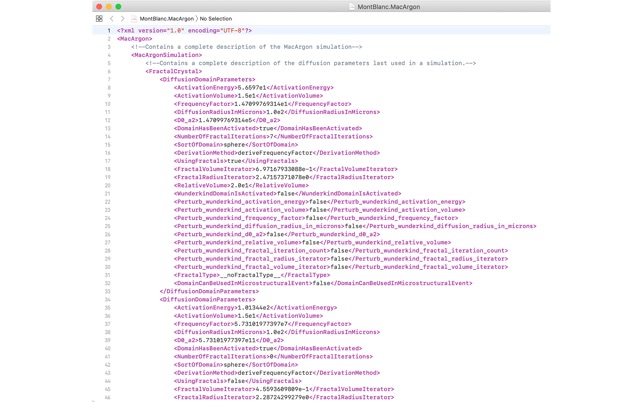
Latest release of the MacArgon diffusion modelling software that was used for the presented work.
http://rses.anu.edu.au/tectonics/programs/MacArgon/index.php